Taxi scams at Orly and Paris airports: how to spot a fake driver
The taxis waiting at the rank outside Orly are official, licensed and regulated by the Paris police, and they are safe to take. The trouble starts before you reach them, with a stranger in the arrivals hall offering you a car, or a driver who names a price only once your bags are in the boot. Here is what a real Paris taxi looks like, how the fare is set, what to check in an Uber or a Bolt, and where to complain if it still goes wrong.
🛡️ How it usually starts
You come through the doors of the arrivals hall, tired and a little lost, and someone walks up to you with a few reassuring words and the offer of a car waiting just outside. It sounds helpful. It is also the exact approach Paris Aéroport warns travellers about, and it starts with a conversation rather than with a car.
Our own drivers see these touts regularly. They wait near the drop-off lanes and around the car parks, looking for travellers who have nothing booked. The tone stays reassuring until everyone is seated and the doors are shut. Only then does the price come out, far above anything official, and a visitor in an unknown car, with luggage in the boot, usually pays rather than argue.
Paris Aéroport, which runs both Orly and Charles de Gaulle, gives one simple rule against this. Refuse any driver who approaches you inside the terminal. A taxi you have not booked picks you up only at the official rank, never inside the building, and touting for passengers is banned outright.
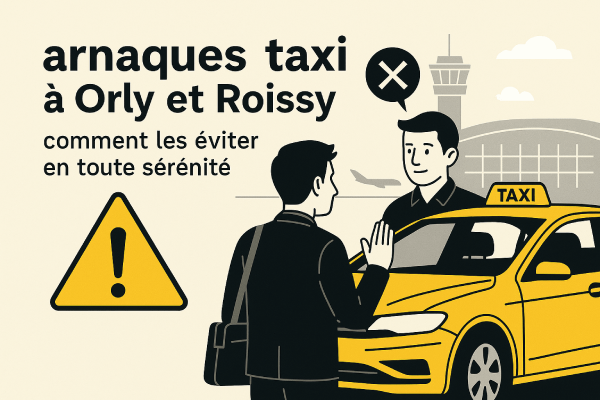
ℹ️ What a real Paris taxi looks like
An official Paris taxi carries a set of compulsory equipment, and it is worth knowing it before you land. On the roof sits a light marked TAXI, with three small lamps showing the fare rate in use. It glows green when the cab is free and red when it is booked or taken. Inside, a meter shows the rate and the running total. A notice with the rules and fares is stuck on the rear left window, and a small plate on the front wing gives the licence number with the word PARIS. The driver also holds a professional card, which the Paris police leaflet lists among the compulsory items.
At Orly, follow the Taxis signs from the baggage hall to the rank outside your terminal. There are separate lines for Paris and for the suburbs, and staff at the rank point you to the next car. Unlike at a street rank, you do not choose your cab at an airport, you simply take the one at the front.
If a car has none of this and its driver found you in the hall, it is not a taxi. The Paris police also warn that such drivers may not have the professional insurance a licensed taxi must carry, which matters a great deal if there is an accident.
💶 The fare into Paris is fixed, so you can check it
Between Orly and any address in Paris itself, official taxis charge a flat fare set by the Paris police. It is the same in both directions, day or night, and it does not move with traffic jams or even with a strike. The amount depends only on whether you are going to the Right Bank or the Left Bank, and Paris Aéroport publishes it on its page on taxis at Orly. Look it up before you land, and a driver who announces something else will not catch you out.
The flat fare covers a direct trip. If you ask for a detour or change the address on the way, the meter is added for the extra part of the route, and a trip with several stops is metered from the start. The rules allow both. A few genuine supplements exist, for booking a taxi in advance or for a fifth passenger. Nothing may be added for your suitcases.
One more detail is useful to know. A Paris taxi driver is not allowed to offer you a flat price for any other trip. If someone at Orly quotes a round figure for Versailles or Disneyland before you have even sat down, that is not a taxi fare.
🗺️ Beyond Paris, the meter decides
Paris Aéroport lists Versailles and Disneyland Paris among the trips for which official taxis use the meter. Both lie beyond the zone covered by Paris taxis’ suburban rates, so once the car leaves that zone the meter switches to rate C, the one otherwise kept for nights and Sundays, whatever the hour, and in slow traffic it counts by time rather than distance. Nobody, including an honest driver, can tell you the exact total before you arrive.
This is where overcharging is hardest to spot. A traveller who has never driven from Orly to Disneyland, in Marne-la-Vallée, has no idea whether the route taken was the direct one or whether a figure is reasonable. Make sure the meter is switched on when you leave the rank, glance at it now and then, and ask for the receipt at the end.
For Versailles, La Défense or a town close to Paris, a price agreed when you book removes the question of the meter altogether.
💶 Paying the driver, and the receipt
💶 Card or cash
Paris taxis must accept a bank card whatever the fare, and cash is fine as well. Tell the driver how you intend to pay as you set off. A card machine that suddenly stops working as you reach your destination is a warning sign, since accepting cards is compulsory.
🛡️ Watch the payment terminal
The Paris police warn about one trick in particular, a terminal with the amount typed in wrong. Read the figure before you confirm, and if the screen is broken or hidden from you, do not validate the payment.
ℹ️ Always ask for the receipt
From €25, the driver must give you a printed receipt in the car, and below that you can ask for one. It shows the date, the times, the licence number, the car’s plate and an address for complaints. Keep it, because nothing proves an overcharge better.
⭐ Tips are up to you
Tipping is not compulsory in a Paris taxi. Round up if the driver helped you, but no one can make it part of the fare.
🚖 Uber, Bolt and Heetch at Orly: check before you get in
Ride apps are legal at Orly, but they work only through a booking. French rules forbid a private hire driver from picking up anyone who has not booked, and they can never be hailed. So a man in the arrivals hall saying “Uber, Uber” is not your Uber. Your app shows the meeting point, usually near the drop-off area of your terminal.
When the car arrives, compare it with the app. Uber and Bolt both ask riders to match the licence plate, the make and model, and the driver’s photo, and Paris Aéroport gives the same advice. A licensed private hire car also carries a red sticker on the windscreen and rear window, with a registration number and a QR code, and the driver displays a secure card behind the windscreen.
Passengers we drive have told us about men with fake cards and fake Uber badges, and about real app drivers who asked for more cash than the price shown in the app. Others, on Uber or Bolt rides, realised only once they were seated that the person at the wheel did not look like the photo in the app, or that the plate or the model was not the one announced. They spent the whole trip unsure who was driving them, or whether that person was a transport professional at all. That is why the check is worth doing on the pavement, before you open the door.
Pay only through the app, refuse any offer to switch off the booking and settle in cash, and report the ride from the trip screen afterwards. Uber has a dedicated option for a driver who asked for more than the fare.
ℹ️ If you think you have been overcharged
A complaint is far easier to follow up when you have a few details in hand, so try to collect them before the car drives away.
- • Write down the licence number on the taxi’s front wing, or the car’s registration plate, and keep the receipt
- • For a Paris taxi, private hire car or motorbike taxi, fill in the online complaint form of the Paris Police Prefecture, which has an English version. A complaint can lead to disciplinary action against the driver, and handling takes about six months on average
- • If you think you were defrauded, you can also report it on SignalConso, the French government’s consumer platform, or file a complaint at a police station
- • If you paid by card and the amount was wrong, contact your bank quickly
- • For an Uber, Bolt or Heetch ride, report it from the trip in the app, which keeps the price you were shown
🚖 Booking a driver before you land
Our company runs private drivers from the Val d’Yerres, a short drive south-east of Orly. When you book with us, the price is fixed at that moment, from €59 for a transfer between Orly and Paris, and nothing is added for your luggage, provided it fits in the vehicle you picked. You can book a private transfer from Orly up to 90 days ahead. You leave a deposit online to confirm the ride. Whatever remains is settled with your driver, who takes cards as well as cash, and it is exactly the amount shown on your booking, never a euro more.
Before the pickup you receive your driver’s name and phone number, the model and colour of the car and its licence plate. Our cars carry the red private hire sticker described above, with the driver’s card on the windscreen. From then on you can reach your driver directly whenever you like, before your flight or after landing, with a call, a text or a WhatsApp message, and share your location on a map if you cannot see each other. When you land, your driver gets in touch to say where they are waiting, or meets you with a sign bearing your name if you ask for one. So you know exactly who you are looking for, and a stranger in the hall has nothing to offer you.
We keep an eye on your flight. Should it be delayed, the driver waits for you until two hours after it actually lands, with nothing added to the price. Every driver on our team is selected by us and speaks English. We fit child seats free of charge when you request them. Plans change too, and cancelling more than a day ahead of the pickup costs you nothing.
❓ Taxi scams at Orly: your questions
What our customers say
Chauffeur ponctuel, véhicule très propre et confortable. J’ai pu arriver à Orly sans stress, je recommande vivement !
Service impeccable ! J’ai réservé pour un rendez-vous à La Défense, tout s’est déroulé parfaitement du départ à l’arrivée.
J’utilise ce service depuis plusieurs mois et je n’ai jamais été déçue. Réservations simples, chauffeurs ponctuels et toujours souriants.
Nous voyagions avec notre fille de 9 mois et le chauffeur avait déjà installé un cosy adapté. Très attentionné et rassurant, un vrai plus pour les parents.
Mon vol avait plus d’une heure de retard et le chauffeur m’a attendu sans supplément. Toujours le sourire, même à minuit passé. Très professionnel.
Nous arrivions d’un long vol, le chauffeur nous attendait avec un panneau à notre nom et a pris soin de nos valises. Très bon accueil.
Je fais appel à eux pour mes trajets professionnels. Toujours à l’heure, jamais de mauvaise surprise. Véhicules propres et discrets.
Nous étions cinq avec beaucoup de bagages. Le chauffeur a tout géré calmement, sièges enfants installés à l’avance. Vraiment pratique.
Le chauffeur nous a guidés jusqu’au comptoir d’enregistrement car nous étions un peu perdus à Orly. Très attentionné et bienveillant.
Siège auto prêt à l’avance et chauffeur très patient avec notre fils. C’était notre premier transfert Orly–Disney, tout s’est déroulé parfaitement.
Départ à 4h du matin, chauffeur déjà là, véhicule chauffé, bouteille d’eau et trajet fluide jusqu’à Orly. Très pro et agréable.
Première fois que j’utilisais ce service et j’ai été bluffée. Confirmation immédiate, chauffeur ponctuel et très courtois. Je referai sans hésiter.
Latest news and travel tips
Practical tips, feedback from the road and useful updates to help you plan a ride with a private driver in Paris. Heading to an airport or crossing Paris for a meeting, we keep you informed.
Air France quitte Orly : Transavia prend le relais, ce qui change pour votre transfert
Air France a quitté Orly le 28 mars 2026. Découvrez ce qui change pour votre vol et réservez votre chauffeur privé en toute sérénité, quelle qu...
Read the article
Vol tôt le matin ou arrivée tardive à Orly : quelle solution de transport est vraiment fiable ?
Vol très tôt ou arrivée tardive à Orly : découvrez les différences réelles entre taxi, Uber et VTC pour voyager sereinement, même à des horai...
Read the article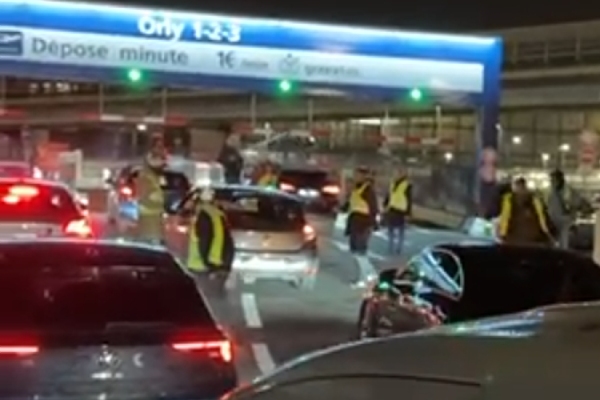
À l’aéroport d’Orly, pourquoi certaines courses Uber, Bolt et Heetch peuvent être bloquées lors des manifestations de chauffeurs
Manifestations de chauffeurs à l’aéroport d’Orly : certaines courses Uber, Bolt ou Heetch peuvent être retardées ou bloquées. Découvrez ce q...
Read the article